My networking logic follows directly from my research question: I need to connect with people who can illuminate the tension between social mask and true self from different angles.
(a) Existing network resources
On a theoretical level, W.E.B. Du Bois’s theory of double consciousness, Bell Hooks and Audre Lorde’s writing on emotion and power, and Elisabeth Croll’s discussion of gender discipline placed on Chinese women form the academic foundation of this project.
On a practical level, I have completed interviews with three Chinese female artists and one Art Director.
Mu distinguished two kinds of dishonesty: dishonesty towards the audience, which can work as a creative strategy, and dishonesty towards oneself during the creative process. She admitted that her work tends to deal with things that can easily “pass” — and what I am questioning is exactly that checkpoint itself.
Zoe has a clear sense of double consciousness: she wants to express vulnerability and fear without filtering, while also being aware that the outside world holds deep-rooted assumptions about what Chinese female artists should be. One conclusion we reached together was: “the dishonesty that comes without thinking is, in itself, a form of honesty.”
Joi lives in the US. Notably, she does not experience a strong sense of double consciousness. She attributes this to both her family’s open-minded attitude and to having left China during high school. This enriches my research: the formation of a social mask is directly related to family background and the point in time at which someone leaves the traditional cultural context.
Art Director Lara Lussheimer introduced the idea of “research out and in”, that researching inward is just as important as researching outward. This speaks directly to the autoethnographic method of this project.
(b) Relationships yet to be established
In terms of independent publishing, I plan to reach out to Hato Press and Good Press. Both focus on self-published and independent printed matter and are among the most influential spaces in London’s zine community, to understand how institutions create space for this kind of expression.
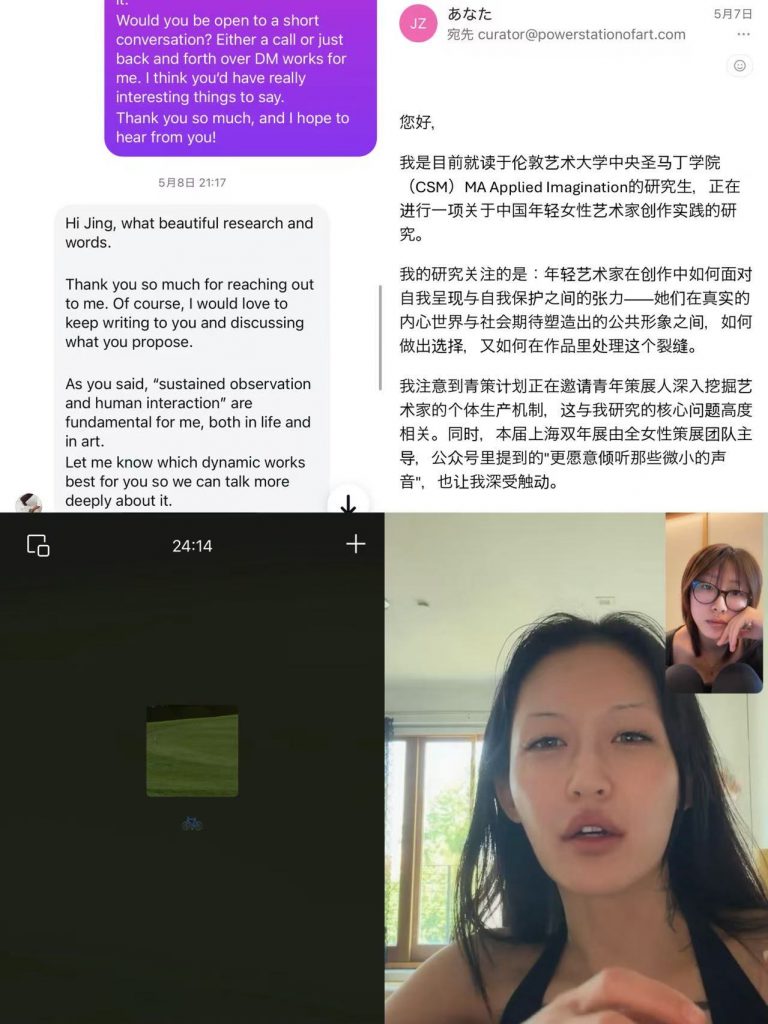
I also plan to contact the Young Curator Programme at the Power Station of Art in Shanghai. They actively support emerging artists within a Chinese cultural context and are one of the few organisations that takes the creative struggles of young Chinese artists seriously as an institutional concern. I want to understand: do they observe structural difficulties around emotional expression and self-presentation in their curatorial process? And what do they believe art can do on this issue?
(c) Interaction plan
I approach all of these connections as a CSM MA researcher, bringing a particular cross-cultural perspective — studying the emotional experiences of young Chinese women from within a Western art institution. This position makes me both an insider and an observer, which I think offers genuine value to institutions and researchers interested in East Asian experience.